
The Clean Hydrogen Partnership and its members have awarded €3 million in funding to HyDRA – Diagnostic Tools and Risk Protocols to Accelerate Underground Hydrogen Storage.
This pioneering EU-funded project aims to advance the understanding and implementation of underground hydrogen storage (UHS) across Europe.
Officially launched on 1 January 2025, HyDRA gathers together eight leading research institutions and one enterprise across six countries: BGR, ESI, IDAEA-CSIC, ISO, KIT, TUC, UEDIN, UiB and UNINA. These institutions are collaboratively addressing the pressing need for large-scale hydrogen storage solutions to support Europe’s transition to a low-carbon energy future.
Enabling Large-Scale Hydrogen Storage in Europe
To meet the EU’s climate targets, diversify the energy market, and ensure a reliable energy supply, expanding hydrogen infrastructure is crucial. Large-scale storage solutions are needed, as current facilities cannot handle the anticipated increase in hydrogen availability.
Storing hydrogen underground in naturally occurring sealed formations, such as sedimentary basins, presents a significant opportunity for Europe. These formations are robust, have large storage capacities, are cost-effective, and can be easily integrated into existing systems.
However, critical knowledge gaps remain, particularly regarding how microbial processes might influence underground storage. The HyDRA project aims to address these gaps by developing scientific protocols and regulatory frameworks to ensure hydrogen can be stored safely and efficiently.
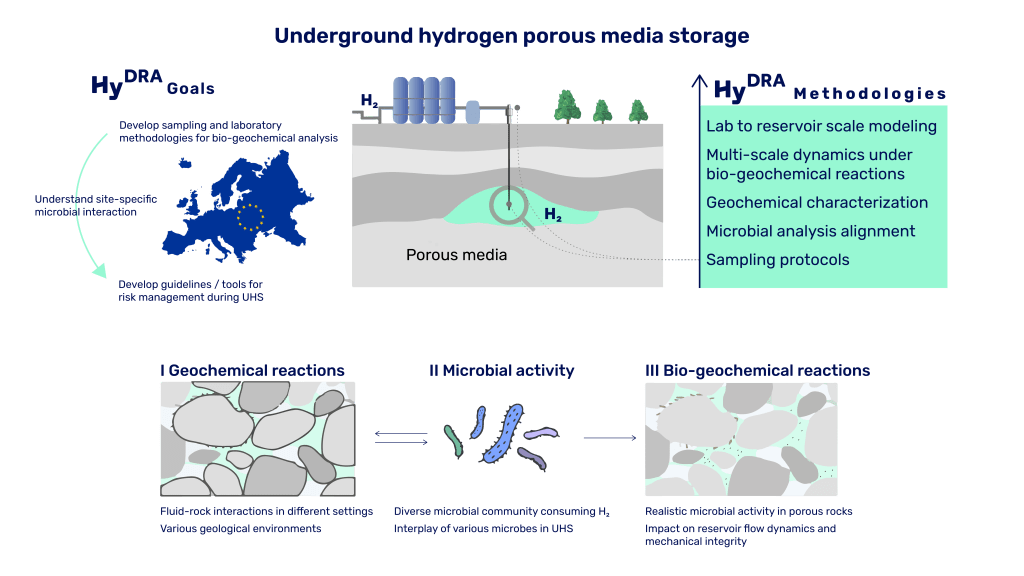
Key Objectives of HyDRA:
- Innovative Research:
Investigate hydrogen-consuming microbial activity and its interaction with storage formations to establish risk mitigation strategies. - Methodology Development:
Enhance understanding of bio-geochemical processes affecting hydrogen storage in porous media. - Standardization and Regulation:
Provide science-based recommendations to support the development of ISO standards and regulatory codes for underground hydrogen storage.
A Comprehensive, Europe-Wide Approach
HyDRA is collaborating with a network of storage site operators (SSOs) to ensure broad geographic coverage and minimize duplication of research efforts. The project includes over 20 sedimentary basins across Europe, representing a range of geological conditions, pressures, temperatures, and depths.
Additionally, HyDRA will incorporate bio-geochemical sampling of natural hydrogen seeps and accumulations to analyze microbial communities in hydrogen-rich environments. This data will be instrumental in shaping monitoring and remediation technologies for safe and efficient UHS deployment.
For more information about the HyDRA project, visit www.hydrahydrogen.eu or contact contacthydra@uib.no.

Key Info:

Project consortium:
- BGR (Federal Institute for Geosciences and Natural Resources)
- ESNZ (Earth Sciences New Zealand)
- IDAEA-CSIC (Institute of Environmental Assessment and Water Research at Spanish National Research Council)
- ISO (Isodetect GmbH)
- KIT (Karlsruhe Institute of Technology)
- TUC (Clausthal University of Technology)
- UEDIN (University of Edinburgh)
- UiB (University of Bergen)
- UNINA (University of Naples Federico II)

Period duration:
2025 – 2028

Disclaimer:
The project is supported by the Clean Hydrogen Partnership and its members. Co-funded by the European Union under Grant Agreement No. 101192337 — HyDRA. Views and opinions expressed are however those of the author(s) only and do not necessarily reflect those of the European Union or the Clean Hydrogen Partnership. Neither the European Union nor the granting authority can be held responsible for them.



 HyDRA - diagnostic tools and risk protocols to accelerate underground hydrogen storage
Leave a comment